Before everything changed, Eden was quiet.
Not the kind of quiet that feels empty, but the kind that makes you forget that the world could ever be different. The trees stood without fear. The flowers grew without being planted. Even the evening air seemed to know where it belonged.
Then there were the two fruits.
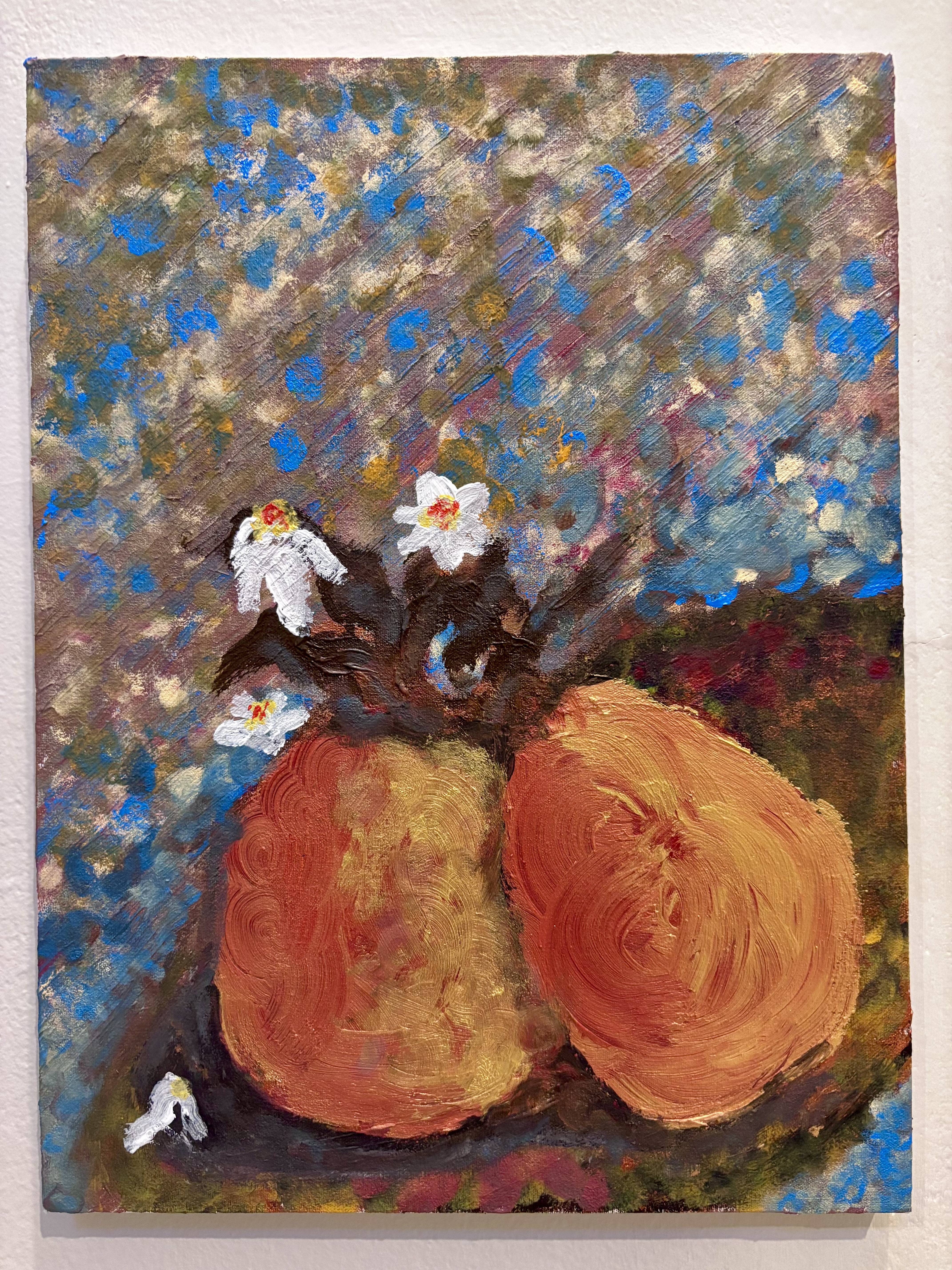
They rested close together, almost touching, beneath a small branch of white flowers. One was darker, deep red and gold, while the other carried the warm color of a late sunset. They looked ordinary enough. Beautiful, certainly. But nothing in Eden was supposed to be ordinary.
The man and the woman stood beside them.
Perhaps they already knew that something was wrong. Perhaps they did not.
There was a strange stillness in the garden that evening. The sky was no longer the soft, endless blue it had always been. Colors seemed to gather in the distance—blue, brown, gold, and red—like the last light before a storm.
And still, the fruit remained beautiful.
That is what makes the story difficult.
The forbidden thing was not ugly. It did not announce itself as danger. It simply waited.
For a moment, the woman looked at the fruit. The man looked at her. Between them was everything they had ever known—and everything they were about to lose.
Perhaps this is the moment I imagined while painting The Eden’s Fruit.
Not the moment of eating.
Not the moment of punishment.
But the moment just before.
The last moment when Eden was still Eden.
The thick strokes of paint are deliberately restless. The flowers remain white and innocent, while the colors around them begin to break apart. The fruits sit heavily in the center, almost glowing against a garden that seems to be slowly losing its peace.
There is something romantic about that final moment, too. They were together when the world changed. Whatever happened next, they would face it together.
And perhaps that is why the painting is not entirely about temptation.
It is about the fragile beauty of the last moment before paradise becomes memory.
| Title | The Eden’s Fruit |
| Year | 2026 |
| Genre | Naïve Impressionism, Expressive Impasto |
| Size | 30 × 40 cm |
| Medium | Acrylic on Canvas |
| Suitable for | White or warm-neutral living rooms, particularly above a wooden console, sideboard, or reading chair where the deep reds, oranges, blues, and earthy greens can stand out against a light wall. It would also suit a private library or study, especially beside dark wooden bookshelves, vintage furniture, or a leather reading chair, giving the room a slightly biblical, mysterious atmosphere. |
| Condition | Original one-of-a-kind artwork. No copy or reproduction will be made. |
| Price | US$120 |

