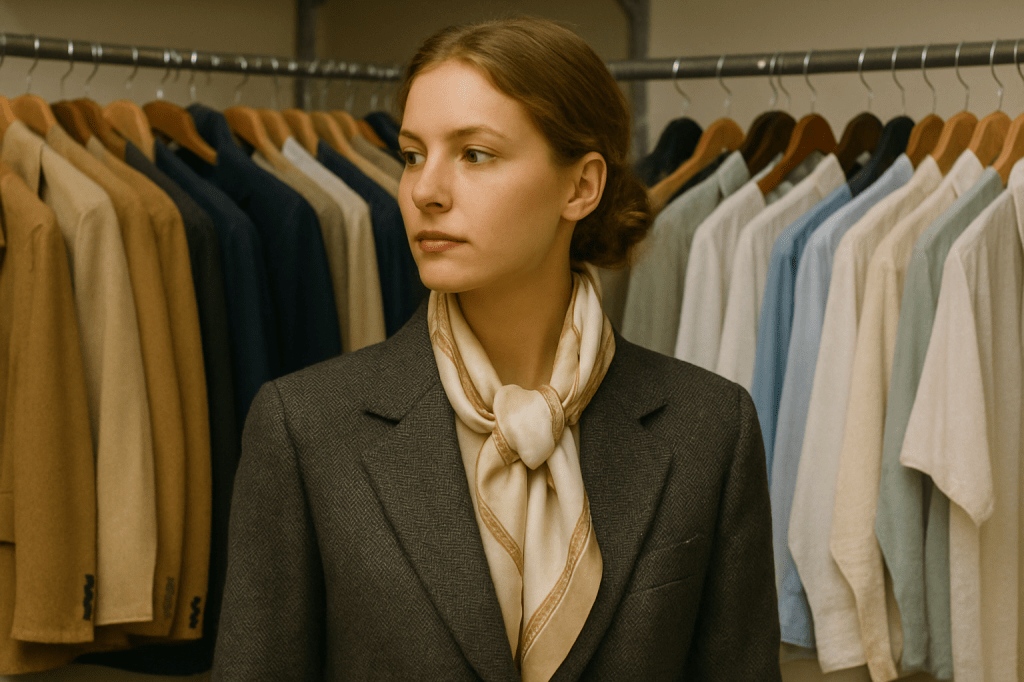
There’s something about the weight of old wool on your shoulders that makes you walk differently.
Maybe it’s the structure. Maybe it’s the whispered stories woven into the lining. Or maybe, just maybe, it’s the quiet luxury of knowing you found something timeless—for less than the price of a smoothie.
I used to think “rich” meant shiny. Brand new. Crisp, fresh out of the box.
Now? Rich feels like the subtle slouch of a vintage linen pant, the whisper of silk at the neck, the scent of a gently-worn herringbone blazer that still carries a hint of pipe smoke and cedar.
This is the eco quiet luxury life—and I thrift it all.
💼 The Wool Blazer That Changed My Posture
I found her in Paris.
Not in some curated vintage shop with jazz music and $300 price tags—but at a literal side-street thrift box on Rue Oberkampf. Rainy Tuesday. My umbrella had flipped inside out, and I was running from one casting to another.
Then I saw it.
A dark brown wool blazer, perfectly boxy, with thick tortoiseshell buttons and a tag that simply read:
“Massimo Dutti, 1991. Made in Portugal.”
I slipped it on and… stopped.
It smelled faintly of grandma’s attic—not musty, but comforting. Like lavender sachets and old Polaroids. The kind of scent that makes you straighten your back and tuck your chin slightly. Instant poise.
€8. That’s all.
For a piece that now lives on my shoulders like armor, like history. I wear it with everything—jeans, trousers, over slip dresses, under trench coats. It’s my go-to when I want to feel like I run a family estate but also compost religiously.
🧣 Scarves That Make You Whisper
Scarves are where the real gems hide.
I once found a 100% silk Écho Paris square scarf in the back bin of a Savers in Long Island. It was folded into itself like a secret, still sharp at the corners. Navy, cream, and rust paisley. I remember because the man behind me in line complimented it before I even bought it.
$4.99.
I drape it over my hair on humid days or tie it around my bag handle. Once, I wrapped it around my wrist before a photoshoot, and the photographer asked if it was vintage Hermès. I just smiled.
Quiet luxury isn’t about the label. It’s about how the piece behaves.
Silk flutters differently when it’s aged. It picks up the wind in a way that fresh poly never will.
My tip: always run your fingers over the edge hem. Hand-rolled hems = quality.
👖 Linen Pants, and the Art of the Slouch
I used to think I couldn’t “pull off” linen. I thought it wrinkled too easily, made me look disheveled. That was before I learned the beauty of ease—and the secret: thrifted linen is already broken in.
I found a pair of wide-leg cream linen trousers at a market in Tokyo, tucked beneath a faded pile of jeans. No brand label, just a handwritten “L” on the waistband.
They were a little long, a little loose, and completely perfect.
I got them hemmed for $10, then wore them every day the rest of the trip—with tank tops, tucked-in knits, even barefoot once on a beach shoot.
They cost me 700 yen. About $5.
The way they drape? Rich. The way they whisper when I walk? Whispers louder than logos.
💬 “But How Do You Know What’s Good?”
I get this question a lot.
Especially from other models just starting out, watching their wallets but wanting to build a look that says: yes, I read Vogue—but also French philosophy, barefoot, by the fire.
Here’s how I thrift quiet luxury:
🛍️ My Go-To Thrifting Rules:
| Category | What to Look For |
|---|---|
| Blazers | Made in Italy/Portugal tags, wool blends, inner lining weight |
| Pants | Natural creases (linen or wool), inner tag = care quality |
| Scarves | Silk or wool-silk blend, rolled hem, soft color palettes |
| Tops | Neutral tones, silk/cashmere content, single-stitch details |
| Shoes | Leather soles, solid arch, brands like Bally, Ferragamo (yes, they show up) |
Also, trust your senses. I’ve literally picked something because it felt right in my hand—weighty, soft, intentional.
🧠 It’s Emotional, Not Just Practical
Let me be real for a second.
I didn’t start thrifting just to save money or find cool clothes. I started because I was tired of being told what beauty costs.
Fast fashion made me feel like I had to buy new to be new. But when I’m in a secondhand store, with Billie Holiday playing overhead and hangers clicking softly, I remember:
I’m not building a wardrobe. I’m collecting fragments of other lives.
The woman who wore that camel wool coat in the ’80s. The man who gifted that red silk tie and had it returned. The girl who bought that linen dress for graduation.
And now I get to continue their stories.
It makes dressing so much more… human.
🌱 Quiet Wealth, Loud Impact
Let’s talk numbers, too.
That $8 Massimo Dutti blazer I mentioned? A similar modern wool blazer retails for around $250–$400. And often? They’re blended with polyester or viscose. Mine is 80% virgin wool, lined in rayon, and stitched to last.
My $5 silk scarf? Current Écho scarves sell for $110–$140.
Thrifted fashion isn’t just sustainable. It’s financially smart, emotionally rich, and culturally rebellious. You’re choosing story over spectacle.
That’s real luxury.
Final Thoughts: Your Richest Look Starts With What You Already Own
Quiet luxury isn’t quiet because it’s shy.
It’s quiet because it doesn’t need to explain itself.
I’ve walked into castings wearing head-to-toe thrift and had agents say,
“You look like old Celine, but with better skin.”
I’ve styled entire editorials with $20 outfits and watched them get published in high-gloss magazines.
Because here’s the secret: It’s not about cost. It’s about cohesion. Confidence. Context.
So the next time you walk past that dusty thrift store or market bin, don’t just keep walking.
Go in. Run your hands along the wool. Peek behind the scarves. Check the seams. Smell the tweed. Find something that makes you stand taller—not just in posture, but in presence.
You don’t need to shout. Your style will do the whispering.
And darling, it whispers wealth.







 a Models Secrets